Saturday, August 6, 2011

Rain barrels and rain chains

After the rains over the last 10 days, I'm convinced that rain chains simply won't work with typical rain barrel setups.  The rain chains are aesthetically pleasing, and they disperse the water in a way that doesn't cause erosion, but the water is broadcast too widely, even if your rain barrel is topped and surround with plants all around.

While it's easy to drain the water on top, it's difficult to screen that water, which is typically filled with small leaves and other things that will clog spigots, valves and our sprinkler and soaker hoses.


My rain barrels fed (poorly) by rain chains.

Tuesday, August 2, 2011

Spiny Softshells of the Ohio River Watershed


Our Hampshire County watersheds mostly drain into the larger South Branch, Cacapon, or Opequon  watersheds, or directly into the Potomac.  During my adventures with the West Virginia Youth Science Camp in the Kanawah/Ohio watersheds, we saw a few things that surprised me, but the juvenile Eastern Spiny Softshell turtles (Apalone spinifera) were the biggest surprise.

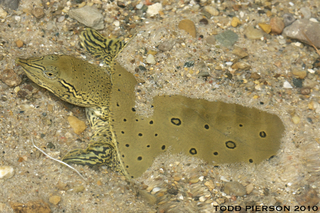
While geocaching on July 12, Stephanie and Rachel found this softshell below one of the Cedar Lakes dam's spillway after a rain.  I worried that it would be in danger as the grass dried in the 35oC temperature (and as the grounds crew began mowing), so Rachel placed it back in an aquatic environment.

On July 15 we found an even smaller softshell in the recently mowed grass heading uphill and across the road to one of the lakes.  I made the decision to accelerate it's journey because of the roadway.  The lake had a few very large snapping turtles - we noticed a few geese with missing feet and broken legs - but the lake certainly seemed safer for an aquatic turtle than a road.

During college I worked with Florida Soft-shelled Turtles at ZooAmerica, and apparently the Eastern Spiny Softshell is just as fast, and similarly aggressive as a hunter.  Its shell is smooth except for the small spines on the front of it's shell that give it's name.  The spots also seem to distinguish it from the smooth softshell also found in parts of the Ohio river watershed.
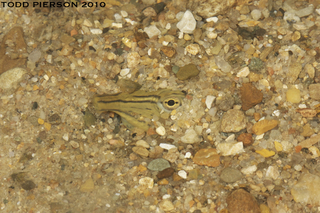
 It is primarily a river turtle, and it likes to bury itself in the sand or sandy gravel or mud of river bottoms with only it's snout visible (see photos below).

Most interesting to me is that it can get oxygen from the water. Its embryonic pharyngeal gill slits (which all vertebrates have) become a highly vascular pharynx with a lining thin enough to remove oxygen from the water.  I haven't found a diagram or image of this yet.  If you find one, add a link in the comments below.

Like other aquatic turtles, it buries its eggs on river banks exposed to the sun; but unlike other turtles, the egg development is not temperature dependent.

Great aquarium photos of A. spinifera burying itself:


This USGS map shows A. spinifera's indigenous (native) range and recent non-indigenous findings outside the Ohio/Mississippi watersheds.

Native range is brown-orange

Saturday, July 23, 2011

Dog-Day Cicadas

Annual Cicadas (Genus Tibicen) are often known as Dog-day cicadas because they appear in the "dog days" of July and August. Michelle found this cicada on July 14 during our group hike in Kanawha State Forest, and it's the first cicada I had seen this year.  It is most likely Tibicen canicularis, which is sometimes called the Dog-day Harvestfly.

Cicadas are found almost worldwide (everywhere except Antarctica), and they're in one of two families:  Tettigarctidae (limited to Australia and Tasmania) and the much more common Cicadidae.  They are not related to locusts (swarming grasshoppers), but many people call them locusts mistakenly.

Unlike the 13 and 17-year cicadas, annual cicadas have only a 2-3 year life cycle underground.  And because of overlapping "generations", we see them every year.


Image retrieved from City-Data.com

Over the next few weeks, you might also see the ground-dwelling Cicada-Killing Wasps ( Genus Sphecius).   Image retrieved from City-Data.com


Other photos from the hike in Kanawha (locals seem to pronounce it can-ahh) State Forest:

The whole group:

Cayla with two big crayfish and a big leaf from a streamside Umbrella Tree (Magnolia tripetala).

Thursday, July 7, 2011

Young Snapper

Young common snapping turtle (Chelydra serpentina)

I found this little future monster when I walked down to the ponds to check on a project we started to evaluate soil moisture requirements of three different species of Hibiscus:  Rose Mallow (Hibiscus moscheutos), Swamp Rose Mallow (Hibiscus moscheutos palustris or syn. Hibiscus palustris), and Hairy Rose Mallow (Hibiscus lasiocarpus).

The common snapping turtle (Chelydra serpentina) is a large freshwater turtle with a bad attitude and a very mobile head and neck (presumably the origin of the name serpentina).  Because they don't have many predators, their upper shell can grow to be a half-meter (50cm or almost 20 inches), and they can weigh over 30kg (over 65 pounds), but they're much more common at about half that size.

Last year, just after completing the new turtle pond, we found an adult female laying eggs.  I thought she was merely stuck on the bank and lifted her up the steep muddy slope, only to discover the eggs below.  That ruined my day.

Tuesday, July 5, 2011

Video of a Hummingbird Moth

On Sunday, July 3 we saw our first Hummningbird Moth of the summer.  These Lepidopterans are in the Family  Sphingidae (the Hawk moths), and I believe the specific name is Hemaris thysbe.  (the Hummingbird Clearwing - can anyone confirm this?)   Here is a video I took with my phone:


Saturday, July 2, 2011

First weekend in July

Except for some special projects, I finished my last professional responsibilities for the summer on July 1, and this is my first weekend off.  On Thursday I leave for the the National Youth Science Foundation's West Virginia Youth Science Camp near Ripley, WV for 10 days.  We have a lot to do this weekend, but I'll capture a few photos for posting (click for a larger version).

Diane's butterfly garden
Diane's butterfly garden seems to have naturalized, with just a few weeds.  As most of you know, a butterfly garden must have complementary trees available and also a shallow puddle.  The latter is sometimes a challenge in our part of West Virginia.
A second greenhouse
I found this little greenhouse, complete with doors, heaters, motorized baffles and other features for $500 several years ago.  With Jamie's help, we're finally getting it assembled.  I haven't yet dug the trench for water and electricity, but at least it's started.


Wild raspberries everywhere

Saturday, June 25, 2011

Goshawks, Bald Eagle Fledglings, and Young Peepers


Northern Goshawk, (Accipiter gentilis)
Photograph by David Brinker

Earlier this week I read in the Washington Post that someone shot Maryland's only nesting Goshawk (Accipiter gentilis) in nearby Garrett County.  Way back in 1984, I got to care for a Goshawk for the Pennsylvania Game Commission, which used the accipiter for sting operations targeting illegal trades among falconers.  The penalties for all these crimes, in the uncommon occurance when someone is convicted, always seems trivial.

But today (Saturday) I found a very cute little female Wheaton Terrier running loose near Indian Rock in northern Hampshire County.  I hollered around the fisherman's access, but then took her home just a few miles to our farm.  We learned the owner was the visiting daughter of our friend, and when I returned her a little later, I heard the Bald eagles that nest there chirping on the slope above Indian Rock.  These eagles, both the adults and the immature birds, fly up and down the South Branch from the mouth to Milleson's Mill and have nested there for as long as I've lived here.

There are few things that leave an impression like that of an eagle flying by as you're sitting by the river.

===

Yesterday, Anna Hjelmroos took me and Heather Eves on a field trip detailing her Masters degree capstone project at Wolf Trap Farm Park near Vienna, Virginia.  There we saw young Spring Peepers (Pseudacris crucifer), which were so prevalent we worried about squashing them as we walked.  They're so small you'd thing they were spiders or insects of some kind.  They are fast, but Anna caught a few and i got a photo. I've seen ticks larger than these little chorus frogs. We have thousands of peepers on our South Branch floodplain ponds, but I've never seen them this small.


Tiny young spring peepers
Later we followed Wolf Trap Run along the Farm Pond and came upon a cliff that was probably 20-25  meters high on a ridge that is probably less than 100 meters wide, clearly carved by the stream over time.  Another one of those surprises within our National Parks.


The cliffs along Wolf Trap Run


Monday, June 20, 2011

Milkweed blooming

I'm pretty certain it's Common Milkweed - Asclepias syriaca that is currently blooming.  We have a lot, although milkweed sometimes has pollination challenges because the flower design inhibits some insects, and the stickiness is sometimes to much for the more fragile insects, which often die because they're unable to escape.
Common Milkweed - Asclepias syriaca
Our house begins to look buried in wet Junes. 


Scarlet Tanagers and Cedar Waxwings

Image of Cedar Waxwing from Cornell. 
This weekend marked the first Cedar Waxwing (Bombycilla cedrorum) and Scarlet Tanager (Piranga olivacea) we've seen this season.  Both are among our most strikingly colored birds in Hampshire County.

We see lots of Cedar Waxwings travel from the trees on our side of the South Branch to catch insects along the cliffs on the other side.  But most interesting is Cedar Waxwings love of over-ripened, fermenting fruits that leave them intoxicated, sometimes even leading to death by alcohol poisoning.


Image of male Scarlet Tanager from www.Birding.com.


Monday, June 13, 2011

New Intern

Jamie planting grapes on Memorial Day weekend.
Jamie is our new intern at the South Branch Science Consortium. He's a rising junior at MIT in Aerospace Engineering.

We put him to work right away planting grapes and designing a trellis system for supporting the vines. Over the summer, we hope to have him lead a variety of projects in alternative energy, agricultural experiments, and  redesiging our whitewater playspot in the river channel.

Moving dirt.

Rescuing toads.

Tuesday, June 7, 2011

South Branch beaches

The spring floods moved a good part of our upstream beach further downstream.  It's already very popular with canoeists and tubers, but fortunately there have been no fire rings or litter yet.

Looking downstream from our old spot.

I'm not sure what Korry hunts for in the water, but she'll do this for hours.


The following morning.


Monday, June 6, 2011

Potato planting

Our fields were finally dry, and I got the Red and Kennebec potatoes in the ground in two long rows.  I experimented with rototilling followed by a pass with a potato plow, then backfilling with the flattened bucket of the tractor.  It worked well on the float position, unless there was a lot of vegetable matter in the soil, which sometimes caught behind the bucket and scoured the potato groove.

Sunday, June 5, 2011

Freshwater Mussels in the South Branch

Freshwater mussels in the Chesapeake watershed seem much more vulnerable and are certainly less common than in the Ohio River drainage 40 miles west.  I'll bet 80% of those we do see are just empty shells, but I could tell these were alive from 15 feet away.  I've read that there were as many as 14 species surviving in the Potomac back in the 1970's.  Nowadays, fortunately, all are protected.


Sunday, May 29, 2011

Turtle Pond

As soon as we discovered Wood turtles and Painted turtles on our farm I began planning strategies for expanding their habitat. doubled the size of our turtle pond in 2009.  I'm always impressed with how quickly aquatic plants and pioneer species (and invasives) return when there is water.  Our ponds were designed as vernal ponds, relying only on winter and spring rains, but all hold water all year.  The original turtle pond was a tiny, deeper complement to the frog pond, divided by a 15-foot walkway.  The new pond is over three times larger. Special credit goes to Dale Roberts of the Java Shack in Arlington, who while visiting for a recreational weekend, drove the bobcat for nearly three hours straight and dug much of the shallow end.

July 2009


May 2011

Saturday, May 28, 2011

Hollies flowering

Flowers of Ilex opaca
We're at the northern edge of the natural range for American hollies (Ilex opaca), so I pay a lot of attention to our plantings. Those planted in sunlight started blooming this week.

Friday, May 27, 2011

Findings - Turtle eggs and birds nests

While preparing to plant some grapes, I found these turtle eggs.  The only turtles we ever see in this area of the farm are Box turtles (Terrapene carolina).  I haven't been too successful in relocating turtle eggs.  Sooner or later, they're always discovered by a raccoon, fox, skunk, or opossum.  There's only so much you can do to protect them that wouldn't interfere with the young emerging turtles.


Diane found this little nest on the ground.  It seems a little big for a hummingbird.  But what really caught our attention is that on closer inspection you'll see it is made almost entirely of horse hair.  The horse barn is almost 500 meters away, so the little bird that made this must have believed this was the material of choice.  Click on the second picture for a closeup.

Thursday, May 26, 2011

First Hemerocallis blooms

The first Asian daylily  (Genus Hemerocallisblossoms look like they're just a few days away.

Daylily flowers usually last less than 24 hours. They open at sunrise and begin to die off at sunset, but may be replaced by another on the same flower stalk the next day.

Hemerocallis is native to China, Korea, and Japan and elsewhere in Asia, and popular worldwide because of worldwide because of their hardiness. Most  Daylilies grow in clumps, and I've seen them listed on some invasive plants list.  Most of our daylilies came from neighbors who were thinning theirs, so I guess there's some legitimacy to this. I sometimes see them at weird places along the road in the first few weeks of June.

Monday, May 23, 2011

Sad Outcome

They seemed too young to fledge - just two days after the May 21 photo - but both young birds and their parents abandoned the nest.  One died on May 24 on the street (I'll send you the photo if you want).
May 23, 2011
May 24, 2011

Saturday, May 21, 2011

Nesting Doves

I've been reluctant to sneak a photo of the doves that nest every year in one of the hanging baskets on our front porch in Arlington, but this year I did.
An adult doves nesting with two squabs on our front porch in the city.

As abundant as our pigeons (Columba livia) and Mourning Doves (Zenaida macroura) are, we rarely get to see them nesting.  It's too bad , because members of the Family Columbidae have some of the most altricial young (needy or dependent, opposite of precocial).  For the first few days of life, the young squabs eat only a special milk produced from the crop of both the male and female dove.


Here's a photo I found at A birding blog by Gunnar Engblom.of a pigeon (Rock Dove) feeding youg squabs.

Photo: Susannah A. Lower Fraser of Wanderin' Weeta

Sunday, May 15, 2011

Raspberries and Cucurbits

One of the fenced-in raspberry patches.
I weeded the raspberries so my wife could plant her pumpkins and squashes among them. When I prepared these 10 x 30 raised beds I used soil from the river bottom mixed with a large amount of organic matter and both composted and new coffee grounds for extra acidity, but the soil still has a significant clay composition. It doesn't affect the output of our plants from what I can tell. I'll wait to hear when Church View Farms begins harvesting their berries and then I'll compare.

I like the combination of the raspberries and cucurbits because the raspberries outgrow the very large leaves of the cucurbits, and there is little sunshine left for weeds.