Friday, October 28, 2011

Morning Fog

I took a few photos during our walk as the fog lifted this morning.  Little arachnids encased these thistles with webs, and I liked how they stood out from the backdrop of the cliffs across the river.


 Jimson Weed (Datura stramonium) is a poisonous plant with an attractive flower.  Some like the look of the rest of the plant (entirely poisonous), but I don't.

The toxins of Jimson Weed produce delirium, where fantasy seems like reality.  Of course that means at one time it probably had many recreational or medicinal uses.
This was a disappointing discovery:  the Mile-a-Minute weed  (Persicaria perfoliata) had produced a bright blue fruit.  I've never seen this before, largely because in previous years we would have removed all the Persicaria by now.

Monday, October 24, 2011

Some Color


The dry summer and wet September apparently wasn't to good for producing leaf color, but this was certainly a nice weekend.


The paw paws (Asimina triloba) along the river have turned a bright yellow.  Elsewhere along the Potomac this is a good time to find paw paw stands to go back next September to collect the very fragile fruit.  My trees are still too young.  Typically fruits begin appearing when the tree is between 3 and 4 inches in diameter.


There's an adult Bald eagle somewhere in the picture above on the left with the blue sky.  We see lots of eagles, but never seem to have a camera ready.

Sunday, October 23, 2011

Preparing the Bird Feeders

While repairing and cleaning the bird feeders, we found this one had a surprise inside.  When I split the casing you could see the wasp larvae and their casings.  I'm still trying to determine exactly what species of wasp built this.


Wednesday, October 12, 2011

The Last Hibiscus Bloom?

I was surprised to see this full bloom on October 11.


Sunday, October 9, 2011

Classroom Trees

Back in 2001, I was disappointed to see elementary kids sending pickup truck loads of seeds off to the state nurseries without keeping any to grow themselves.  Most teachers will tell you however, any tree planted on school grounds is vulnerable.  Even in urban areas, rodents, rabbits and deer can wipe out a class project overnight.  And well-meaning custodians sometimes get carried away with their weed-whackers and mowers.
So in 2006 I called the very nice folks at the Potomac Conservancy who ran the Growing Native program and told them about my strategies for growing trees inside classrooms.  We held some teacher workshops over the next few years and now many schools have Grow-Out Stations.  The slides from one of those workshops are still available on the Growing Native website and at TreesInSchools.org.or ChestnutsInSchools.org.


There's not much to it.  I collected more than 40 old recycling bins when Arlington County Virginia distributed larger bins, and gave most away to teachers.  You can find similar size bins anywhere, often for just a few dollars.  I continue witht he recycling theme by using corn-based plastic cups from my morning iced coffees, or from ubiquitous Big Gulp cups for individual planters within the larger bins.

Most tree seeds require cold stratification of 60 days or longer to germinate, easily simulated in a refrigerator. Some also require scarification to weaken the seed coat that allows the embryo to break free.  Others, like white oaks, will germinate almost as soon as they hit the ground.  You can use natural soil if it's loamy, but clay will harden, crack, and fail the plant.  Otherwise, consider potting mixes.

The most important step, particularly if you decide to keep the bins outside, is to protect the seeds from squirrels.  It may not be an exaggeration to say they're watching you while you plant these seeds.  If inside, the major threat seems to be from kids overwatering the young seedlings.

Tuesday, October 4, 2011

Cool Portable Field Microscopes


As a biology teacher, I was always glad to have a prism field microscope around, but these new hand-held tools are great if you've got a tablet (iPad), iPod, smart phone, or laptop with you.  Magnification is up to 200x.

Click on the top photo and look closely to see the little pollinators within the flower.

I'll post the company details here.


Sunday, October 2, 2011

September Rain

September Rains
 We had over four inches of rain during the last few weeks of September.  We wish we had planted grass, but it seems there is more rain to come.

Historical weather is not as easily avialable as I wish.  The easiest to find is from NOAA, but the closest recordings are Martinsburg and Hagerstown.

Our dwarf lime plants seemed to thrive, but we're moving them inside this week.  We didn't apply a horticultural oil or other insecticide, so we'll probably enjoy the sticky mess of scale insects later in the winter.


I'm not an avid mushroom hunter, but autumns like these are terrific for harvesting Chicken of the woods and Hen of the woods (Maitake) and other mushrooms.  In the city, Maitake mushrooms go for as much as $1 an ounce (over $15/pound).  

Do your homework and go with someone who knows what they're doing.

Monday, September 26, 2011

Outdoors in Poland

I subscribe to the Hampshire Review electronically, but I realize now I could have taken a photo of me looking at the online version.  Instead, here are a few photos of my 10-day work trip to Lodz (pronounced "wooch"), Poland's third largest city, from September 14-24.  I was visiting there with two colleagues to help the University of Lodz MBA program faculty introduce curricula in cybersecurity and entrepreneurship, and our Polish colleagues were great about showing us all around.

One of the first things I noticed from the plane, and on the train from Warsaw, is that many, many farms are only about 100 meters wide but a whole kilometer long (330 feet x 3300 feet).  I'm guessing that allows everyone to have close neighbors and road frontage.


European sycamores (Platanus orientalis) are sometimes called Planes.  They appear very similar to our Platanus occidentalis.

These are different than Norway Maples (Acer platanoides), which were common in Lodz (and considered invasive in the U.S.).


Another tree that was very common, and more familiar to Americans, is the Horse Chestnut (Aesculus hippocastanum).  People collect the seeds for good luck and to make crafts. They have a very nice drooping canopy and they were found all over.
The Aesculus seeds have an armored husk, but nothing like American Chestnuts (Castanea dentata) or Chinese Chestnuts (Castanea mollissima).


For those that like to explore nature with technology, I saw a few trucks we don't get to see here in the U.S.  There was this red Nissan Patrol, which has been sold around the world since 1951, but only available here since last year as a more upscale Infiniti QX56.


There were also these Hyundai Gallopers, which is the modern version of the Mitsubishi Pajero, sold here in the U.S. for a while as Mitsubishi Monteros.  Unlike Toyota Land Cruisers, Suziki Jimnys (Samurai's here), and the Nissan Patrols, which were all made in coordination with the U.S. Government back in the 1950's, these Mitsubishi/Hyundais didn't appear until the 1980's.


Tuesday, September 6, 2011

Bad Timing

We spent about $500 in equipment rental (Bobcat 335 mini-excavator), $75 in Diesel fuel, and about 30 hours of hard labor this weekend on streambank repair and wetlands restoration. Today it appears much of our work could be underwater within three days! Just another one of our farm projects we'll have to call "an experiment".

Here is the September 6 prediction. Click on the image to see the current forecast.

Saturday, August 27, 2011

It appears the desert of northern Hampshire County may get some precipitation from this storm afterall.

Wood House Research Farm / South Branch Consortium Weather


WeatherLink Network
South Branch Science Consortium
Current Conditions as of 16:56 Saturday, August 27, 2011
Station SummaryCurrentToday's HighsToday's Lows

Outside Temp74.3 F86.4 F00:0066.9 F11:26
Outside Humidity95%97%11:3746%00:05

Inside Temp79.9 F81.5 F00:0076.0 F13:27
Inside Humidity52%55%12:5348%00:00

Heat Index78.0 F90.0 F00:02
Wind Chill74.0 F67.0 F10:34
Dew Point73.0 F73.0 F17:5763.0 F00:05

Barometer29.597"29.874"05:1529.596"23:54
Bar TrendFalling Rapidly

Wind SpeedCalm12 Mph19:41
Wind DirectionWSW 242°

12 Hour ForecastPartially Cloudy, Rain within 12 hours

Wind2 Minute10 Minute

Average Wind Speed0.3 MphCalm
Wind Gust Speed4.0 Mph

RainRateDayStormMonthYear

Rain0.00"/Hour0.20"0.20"1.40"23.13"
Last Hour Rain0.00"


NOAA Rader Loop (left-click to zoom)

http://radar.weather.gov/radar.php?rid=LWX&product=NCR&overlay=11101111&loop=yes

Monday, August 8, 2011

Cotton, Peanuts and Naked Ladies

Click here for interactive map
I gave a presentation in Suffolk, Virginia last Thursday, and found a short period of time to go scout the perimeter of the Great Dismal Swamp, one of the largest national wildlife refuges in the U.S.  On the way there, I saw fields of cotton, peanuts and soybeans.

I was surprised by the bare soil surrounding the cotton, which suggests high herbicide use.  I learned that cotton growers also employ an exfoliant toward the end of the growing season, and that enables easier collection of the cotton.

Cotton field near Suffolk, VA

I learned a lot about peanuts too, and have been thinking about how they'd do in the alluvial flood plain soil along the South Branch that is an unusual mix of sandy clay.  Most sources say sand is good, clay is not.  That sounds like an experiment to me.

The Swamp

Great Dismal Swamp boardwalk
I had very little time to explore the Great Dismal Swamp, so I stopped in the refuge office, got a bird list, and the staff there uniformly recommended a short loop trial that visits multiple habitats typical of the swamp.

Bike trail in the Great Dismal Swamp
When I asked  how to spend a few days visiting the swamp when I had more time, they also agreed that a mountain bike in April/May is best.  With over 100 miles of interior hiking/biking trails and very comfortable lodging in Virginia Beach, the Outer banks of North Carolina, or at the Hilton Garden Inn Riverfront in Suffolk, that sounded like a plan.


Read more about the Great Dismal Swamp here.


Naked Ladies


When I returned to Hampshire County I saw Naked Ladies everywhere.  Their scientific name is  Amaryllis belladonna, and they're native to South Africa.  I have a few dozen thanks to my neighbor Puddy in the city, who regularly rewards me with neighborliness when thinning her garden.
Amarylis surround my farm equipment.

Naked ladies are also known as Belledonna lilies, and they have been popular with gardeners since the late 1700's because of their habit of producing leaves in fall or wet springs, then remaining dormant until now and suddenly sprouting a single stem with an attractive flower.  I like them because they are toxic to deer and groundhogs.

Experiments in Hibiscus Propagation

I've had lots of disappointments in propagating local and historically indigenous rose mallows (Hibiscus spp.)  They were the first plants in pre-colonial America to be cultivated for shipment back to Europe.  The seeds we've collected from locally growing Hibiscus moscheutos (white/cream-colored flowers the size of dinner plates) are always infested with mites that are not killed by freezing.

We ordered seeds of Hibiscus moscheutos, Hibiscus laevis (syn. militaris), and a subspecies of H. moscheutos often called H. paulstris (actually Hibiscus moscheutos palustris, Swamp Rose Mallow) from Prairie Moon Nursery.  We direct-sewed them naturally (as if they'd fallen from the plant's seed pod), and then spent many, many hours trying more advantageous seedings.  We've truly only been regularly successful when sewing the seeds in April in the greenhouse and then transplanting after germination (about 100x more work than our preferred approach!).

So now I'm convinced the only strategy for sewing seeds directly is to do so in situ after the last frost, in areas with appropriate moisture,  That's not easy, as that is our wettest time of year, and if you observe native H. moscheutos you'll see they grow immediately next to but not in the water.
That said, when the experiments are successful, the colors are impressive.     We fence anything (everything!) we transplant.  Hibiscus generally survive deer well, but as many of you know, deer usually don't know they don't like something without trying it at least once!
from http://www.visoflora.com/#
I don't know who this kid is, but I wanted to provide an example of the size of these flowers.


Sunday, August 7, 2011

Growing Citrus in the Eastern Alleghenies

I'm curious to know what cycles others in Hampshire, Morgan, Mineral and Hardy Counties have witnessed in growing lemons, limes and other citrus.  The folks at Nature's Art in Cumberland (a very pleasant, easy place to spend money) started me growing lemons and limes last year.  Most start producing fruit in April and May indoors.  We move them outside after mid-May (about 10-14 days after the predicted last frost).  Yesterday one of the limes produced a new flower, even with nearly mature limes already present.
(click for a larger view)

Saturday, August 6, 2011

Rain barrels and rain chains

After the rains over the last 10 days, I'm convinced that rain chains simply won't work with typical rain barrel setups.  The rain chains are aesthetically pleasing, and they disperse the water in a way that doesn't cause erosion, but the water is broadcast too widely, even if your rain barrel is topped and surround with plants all around.

While it's easy to drain the water on top, it's difficult to screen that water, which is typically filled with small leaves and other things that will clog spigots, valves and our sprinkler and soaker hoses.


My rain barrels fed (poorly) by rain chains.

Tuesday, August 2, 2011

Spiny Softshells of the Ohio River Watershed


Our Hampshire County watersheds mostly drain into the larger South Branch, Cacapon, or Opequon  watersheds, or directly into the Potomac.  During my adventures with the West Virginia Youth Science Camp in the Kanawah/Ohio watersheds, we saw a few things that surprised me, but the juvenile Eastern Spiny Softshell turtles (Apalone spinifera) were the biggest surprise.

While geocaching on July 12, Stephanie and Rachel found this softshell below one of the Cedar Lakes dam's spillway after a rain.  I worried that it would be in danger as the grass dried in the 35oC temperature (and as the grounds crew began mowing), so Rachel placed it back in an aquatic environment.

On July 15 we found an even smaller softshell in the recently mowed grass heading uphill and across the road to one of the lakes.  I made the decision to accelerate it's journey because of the roadway.  The lake had a few very large snapping turtles - we noticed a few geese with missing feet and broken legs - but the lake certainly seemed safer for an aquatic turtle than a road.

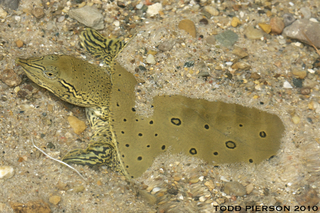
During college I worked with Florida Soft-shelled Turtles at ZooAmerica, and apparently the Eastern Spiny Softshell is just as fast, and similarly aggressive as a hunter.  Its shell is smooth except for the small spines on the front of it's shell that give it's name.  The spots also seem to distinguish it from the smooth softshell also found in parts of the Ohio river watershed.
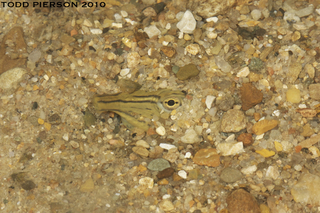
 It is primarily a river turtle, and it likes to bury itself in the sand or sandy gravel or mud of river bottoms with only it's snout visible (see photos below).

Most interesting to me is that it can get oxygen from the water. Its embryonic pharyngeal gill slits (which all vertebrates have) become a highly vascular pharynx with a lining thin enough to remove oxygen from the water.  I haven't found a diagram or image of this yet.  If you find one, add a link in the comments below.

Like other aquatic turtles, it buries its eggs on river banks exposed to the sun; but unlike other turtles, the egg development is not temperature dependent.

Great aquarium photos of A. spinifera burying itself:


This USGS map shows A. spinifera's indigenous (native) range and recent non-indigenous findings outside the Ohio/Mississippi watersheds.

Native range is brown-orange

Saturday, July 23, 2011

Dog-Day Cicadas

Annual Cicadas (Genus Tibicen) are often known as Dog-day cicadas because they appear in the "dog days" of July and August. Michelle found this cicada on July 14 during our group hike in Kanawha State Forest, and it's the first cicada I had seen this year.  It is most likely Tibicen canicularis, which is sometimes called the Dog-day Harvestfly.

Cicadas are found almost worldwide (everywhere except Antarctica), and they're in one of two families:  Tettigarctidae (limited to Australia and Tasmania) and the much more common Cicadidae.  They are not related to locusts (swarming grasshoppers), but many people call them locusts mistakenly.

Unlike the 13 and 17-year cicadas, annual cicadas have only a 2-3 year life cycle underground.  And because of overlapping "generations", we see them every year.


Image retrieved from City-Data.com

Over the next few weeks, you might also see the ground-dwelling Cicada-Killing Wasps ( Genus Sphecius).   Image retrieved from City-Data.com


Other photos from the hike in Kanawha (locals seem to pronounce it can-ahh) State Forest:

The whole group:

Cayla with two big crayfish and a big leaf from a streamside Umbrella Tree (Magnolia tripetala).

Thursday, July 7, 2011

Young Snapper

Young common snapping turtle (Chelydra serpentina)

I found this little future monster when I walked down to the ponds to check on a project we started to evaluate soil moisture requirements of three different species of Hibiscus:  Rose Mallow (Hibiscus moscheutos), Swamp Rose Mallow (Hibiscus moscheutos palustris or syn. Hibiscus palustris), and Hairy Rose Mallow (Hibiscus lasiocarpus).

The common snapping turtle (Chelydra serpentina) is a large freshwater turtle with a bad attitude and a very mobile head and neck (presumably the origin of the name serpentina).  Because they don't have many predators, their upper shell can grow to be a half-meter (50cm or almost 20 inches), and they can weigh over 30kg (over 65 pounds), but they're much more common at about half that size.

Last year, just after completing the new turtle pond, we found an adult female laying eggs.  I thought she was merely stuck on the bank and lifted her up the steep muddy slope, only to discover the eggs below.  That ruined my day.

Tuesday, July 5, 2011

Video of a Hummingbird Moth

On Sunday, July 3 we saw our first Hummningbird Moth of the summer.  These Lepidopterans are in the Family  Sphingidae (the Hawk moths), and I believe the specific name is Hemaris thysbe.  (the Hummingbird Clearwing - can anyone confirm this?)   Here is a video I took with my phone:


Saturday, July 2, 2011

First weekend in July

Except for some special projects, I finished my last professional responsibilities for the summer on July 1, and this is my first weekend off.  On Thursday I leave for the the National Youth Science Foundation's West Virginia Youth Science Camp near Ripley, WV for 10 days.  We have a lot to do this weekend, but I'll capture a few photos for posting (click for a larger version).

Diane's butterfly garden
Diane's butterfly garden seems to have naturalized, with just a few weeds.  As most of you know, a butterfly garden must have complementary trees available and also a shallow puddle.  The latter is sometimes a challenge in our part of West Virginia.
A second greenhouse
I found this little greenhouse, complete with doors, heaters, motorized baffles and other features for $500 several years ago.  With Jamie's help, we're finally getting it assembled.  I haven't yet dug the trench for water and electricity, but at least it's started.


Wild raspberries everywhere