Monday, May 7, 2012

Capturing a Swarm

The old hives are gone.

I burned our old, unused hives last week in preparation for three new nuc (for nucleus) boxes this afternoon.  Brian Umstead offered to replace my old hives because of our setting, and I welcomed the opportunity.

I've researched native pollinators and done workshops on building habitats, but I'm relatively new to honeybees.  In 2005, one of my ninth graders, almost apologetically, asked if he could build an apiary for his project even though there was no control, or independent or dependent variables.  I said, "Of course." and we talked about mentors and training classes with local beekeeping groups.  


After I left to teach at Virginia Tech, he and other students convinced the principal and the school system administrators to keep hives on the roof of the school.  I regularly use this as an example of the importance of student autonomy in project-based learning.  But beyond that, and a few lessons in harvesting honey from Steve Martin at ChurchView Farm, I don't have much  experience with honeybees.


Above:  Brian captures the swarm with sugar water.
Below:  Luring the remaining bees into the hive in the new 
location.
So just as we were finishing, Brian suggested trying to capture a swarm and installing a larger hive.   I grabbed one of the taller ladders and we drove over to Foxwalk Farm.  Brian put on a suit and climbed up with a sugar-water soaked comb to lure the bees from a cedar tree.  A couple hundred climbed on, and I swapped the comb with a fresh one.  But after a short while, it became clear that to get the swarm to come as a whole, we'd need to remove the whole end of the branch they were swarming.  I did the cutting, so I only caught some of the events on video.

We clipped the branches around the swarm and stuffed them all into a box for traveling back to our farm.  The challenge then became removing them from the branch. Eventually, we had to just knock them off, then help those inside the hive attract the rest inside.

We're concerned that we might not have much of a Black locust (Robinia pseudoacacia) bloom this year, but we have an abundance of early and late blooming raspberries, and then Osage orange (Maclura pomifera) that will hopefully keep them interested in staying.


In case you're wondering, the louder, constant hum you here in the background is not the hives, it's Diane mowing on the bigger tractor.


Sunday, May 6, 2012

Mating Wood Turtles

We see wood turtles (Glyptemys insculpta) in and just above the annual flood plain nearly every week from April to October and beyond, but this is the first time I've seen them mating.


Wednesday, April 18, 2012

Snapper


We found this very mature snapping turtle (Chelydra serpentina) near the top of the sand/silt bank to the smaller channel of the South Branch.  The back of her shell was covered with mud, but otherwise we didn't see evidence of egg-laying nearby. If this turtle was laying eggs, it would be about two to six weeks earlier than predicted. Like many reptiles, snapping turtles can store male sperm for several years, possibly because they may sense when conditions are better.  That may be giving them too much credit. If eggs are incubated from 75-80 F (24-26 C), they are nearly always male; but if the surrounding environment is significantly cooler (20 C) or warmer (30 C), they're nearly always female.

Last year we found a snapping turtle that seemed to be struggling up a steep slope.  I've been handling these turtles comfortably since I was a pup, so I lifted it to the top of the steep slope, immediately discovering that it had just deposited about 12 ping-pong sized eggs.  I tried to put her back, but she wanted nothing to do with the nest.  I felt terrible whenever I thought of it, even though I really don't want a bunch of snapping turtles in our ponds.

Monday, April 16, 2012

Spotted Salamanders

After the last big flood, someone must have decided it was easier to bury flood debris rather than remove it.  I'm told FEMA flood insurance often prescribes that, and some floodplain owners have had to watch dozers bury entire trailers in their lower fields rather than pay for big trucks to remove them.   But there is an upside.  It seems that one of every three or four times I discover buried debris, I find big spotted salamanders (Ambystoma maculatum) using it as an underground cavity.  I first learned of these when a good friend and biology major in college had one as a pet, because her father studied the ability of newts and salamanders to regenerate their eyes at the University of Pennsylvania back in the 1980's.

Sunday, April 15, 2012

It's Invasive Time! (Already)

Our interns Jamie and Mary pulled lots of invasive cattails (Typha spp.) from the wetland frog pond last year, but they're back.  I can't remember ever seeing new shoots this early in April.   I got a few by the roots, but I'll bet at least two dozen broke off, leaving the rhizome beneath the surface.  I've never done it, but you can grind the rhizomes to make a flour, and eat other parts too.

Thursday, March 29, 2012

An unusual wind map

I was awakened by the wind, so I thought I'd share this unusual wind map. Click on the image below to see the dynamic version.

Wednesday, March 14, 2012

Chestnut leaves!

American chestnut leaves on March 14, 2012
I keep a few little American chestnuts (Castanea dentata) growing in pots for school visits and other demonstrations.  After two 80-degree days this week, I noticed today that one of the little chestnuts had leaves!

Trees in pots are more influenced by ambient temperatures.  The temperature extremes in regular soil are buffered, whereas potted soil can be warmed almost uniformly.  So, for the same reason that potted plants' roots are vulnerable to extreme cold, this little tree's leaves emerged as a response to warming, presumably triggered by a drop in abscisic acid and a corresponding increase in gibberellin levels.

Saturday, March 3, 2012

Experiments in Spring Flooding

February 26, 2012
By inserting a modest weir and natural rocks in our smaller channel (lower left of top photo) before anticipated minor flooding, we hoped to reverse slow erosion and instead foster sediment deposit so we can add willow stakes and silver maple and sycamore seedlings.

The idea is to slow, stall or gently reverse the flow along the area vulnerable to erosion.  Before we began work, the channel-left bank (river-left or channel-left is always from the perspective of someone traveling downstream, so that means the bank on the right from the cameras perspective in these photos) had a five foot to eight-foot dropoff.

In the second photo you can see the swift flow in the center channel, with pooled water in the area of concern.

I'll share "after" photos when the water recedes.


Sunday, February 26, 2012

First sightings - Robins, Narcissus and Bluebirds

American Robin Bill Purcell.  Next.fronteraaudubon.org
I travel between Zones 6b and 7a several times a week, so I can often predict what's coming for Hampshire County at least one week in advance.

Last week I saw  American Robins (Turdus migratorius) and Daffodils (Narcissus spp.) in the city.  On a long walk on Saturday in Hampshire County I saw the first robin, many daffodil leaves, and another member of the thrush family, Eastern Bluebirds (Sialia sialis).  


This morning along the South Branch, there were robins and bluebirds everywhere.


Daffodils - February, 2012


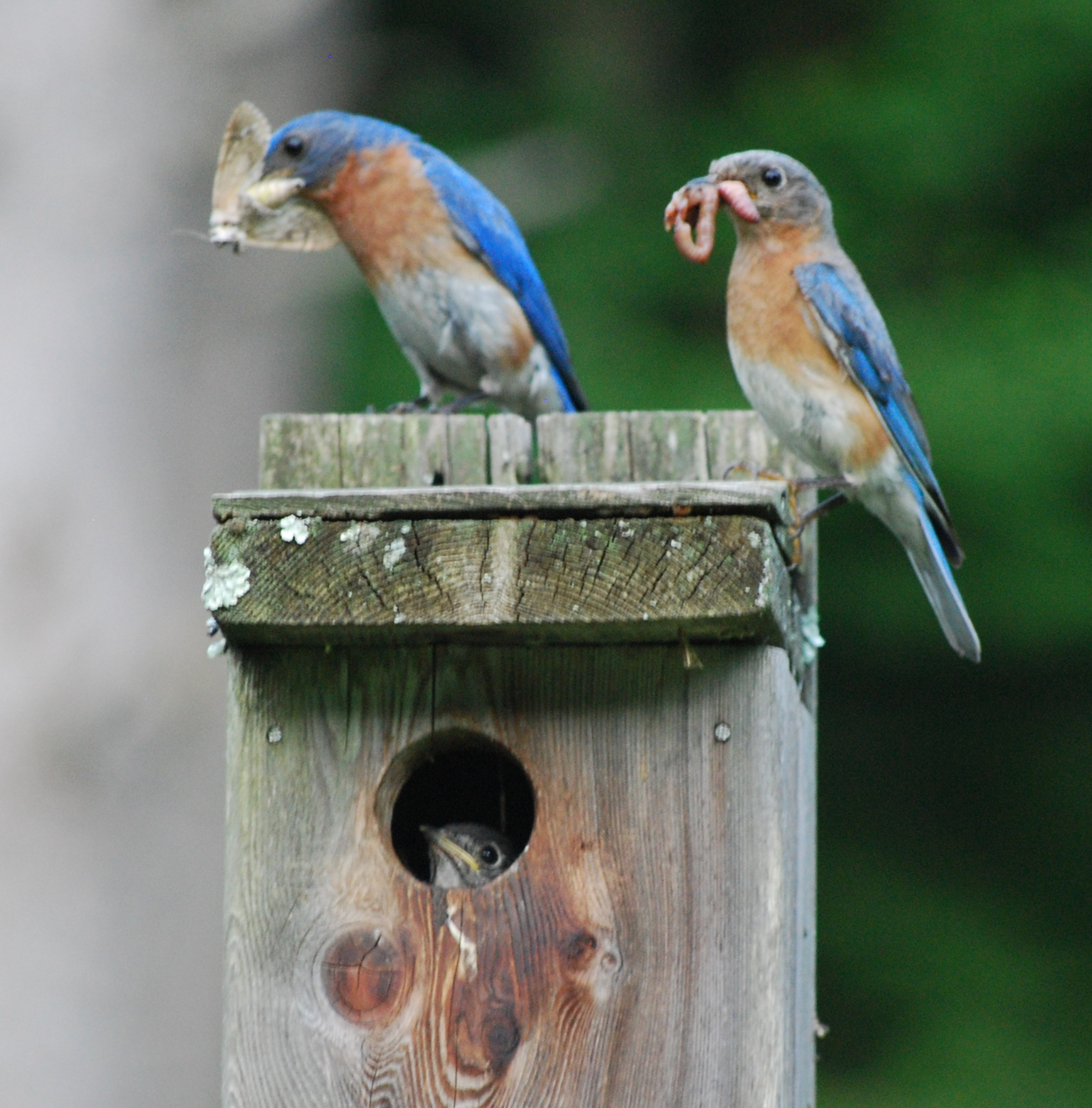
Eastern Bluebird parents. Paula Apro of Eastford CT. 

Tuesday, February 7, 2012

First Crocuses

Shoots from bulbs are triggered almost entirely by sustained increase in temperature of the surrounding soil.  So in mild winters like this one, it's likely they will appear earlier this Spring.  We saw daffodil shoots (Narcissus sp.) over the weekend, and we saw our first crocus blooms (Crocus sp.) this morning.


Crocus is a genus of perennials in the iris family with about 80 species. Crocuses are native to Europe, the Middle East and Central Asia, and south to North Africa.  They are successful at nearly all altitudes, and that's one reason why they do well in the mid-Atlantic.

You've probably seen photos of crocuses blooming in the snow, and it sounds like we'll get the chance to see that tomorrow.

Monday, January 9, 2012

Frosty Mornings

First light on a frosty morning.
Diane and the dogs crossing the big field.

My oldest dog Korry stops back to check on why I'm kneeling.
Most people in the mid-Atlantic region will tell you that witnessing the change of season is important to them.  Of course, that's an underlying theme of this blog.  Based on my current understanding of others' interpretations of climate change data, we may have an increasingly warmer climate, but that will likely be experienced through irregular weather patterns, more snow rather than less, and increases in both flooding and drought.

As an educator, I also align more with those who are putting their energy into climate adaptation, rather than what may or may not be possible in reversing climate trends, which may be entirely due to anthropogenic causes.      I don't look forward to droughts or floods, but I certainly look forward to more snow.  I'm surprised we're still seeing temperature swings in January of 30 oF or more.

But for now it seems will have to settle for frosty and foggy mornings rather than snow.  

Tuesday, January 3, 2012

Eagles in the City

I was commenting that it has been more than three weeks since we've seen a Bald Eagle (Haliaeetus leucocephalus) along the South Branch.  Then today I received an email from my neighbor Greg in the Clarendon neighborhood of Arlington, VA (most densely populated county in the U.S.) that there was an eagle in his tree, and our neighbor Joan got these two great photos.


Best of all, there is good reason to believe the eagle may have been surveying Greg's flock of plastic flamingos, although I wish it would pick off some of the neighbor's free-roaming cats.   What might this mean for the Arlington Egg / Backyard Hen Initiative?  I learned there was another eagle spotted above the Arlington Career Center last month.

Saturday, December 24, 2011

American (Common) Merganser

Mergansers in flight
Source: U.S. Fish and Wildlife Service 

Today was the first time we've seen Common Mergansers (Mergus merganser americanus), the american subspecies of the merganser known as the Goosander (M. m. merganser Linnaeus) in Europe.  These diving ducks always seem to appear just after we notice the South Branch of the Potomac has turned that familiar shade of winter green.


Mergansers have serrated bills, and like other diving ducks, their legs are positioned further back along their body.  This facilitates diving but also requires a running start to get up and out of the water.  They fish cooperatively and have a lot of other behaviors similar to cormorants, but they also nest in tree cavities.  I think of cormorants as among our most primitive birds, so it's interesting to consider these beautiful mergansers as modern semi-aquatic flying reptiles.

Be sure to use the database link in the upper right corner of this blog page to report what you're seeing.

Sunday, December 11, 2011

South Branch Reached Action Level

I'm having difficulty determining just how much rainfall we received last week.  Our own South Branch Science Consortium Weather Station doesn't archive readings online, and with the Oldtown Bridge flooded, I didn't take the time to go to the Wood House from Romney and back on Thursday night.  I went to Romney for the watershed meeting hosted by Melissa Merritt for WVCA, but had to get back to Washington, D.C for meetings the next morning, and I couldn't afford the extra 90 minutes to get the data from the supporting laptop there.

My wife takes our more primitive rain gauges inside for the winter so the ice doesn't destroy them.  I'm a little suspicious of my annual accumulations too, as I've registered less than 30 inches this year, and I'll bet it's the wettest of the seven years I've been in Hampshire.

Every stream I passed from Goose Creek to the North River was significantly swollen, so I wasn't surprised by the spike on the South Branch at Springfield.

Tuesday, December 6, 2011

South Branch flooding, fresh tracks

(Click the photo to enlarge)

We always look forward to walking the beaches of the South Branch of the Potomac after the water recedes.  We have a particular spot where we always find a fresh collection of mammalian, avian and reptilian tracks.

If you recognize any tracks in this photo, post a comment.  Some of the tracks are from our German short-haired  pointers, who always beat us to the river on our walks.

Sunday, December 4, 2011

Deer Management

This is the last week of deer season in Hampshire County until the brief winter private-property season at the end of December.  I've estimated between 40-55 deer per square mile around our area in northern Hampshire County.

Piebald white-tailed deer at Patuxent Wildlife Research Ctr.
Many deer management plans aim to reduce that population to under 20 deer per square mile.  Some metropolitan areas suffer from whitetailed populations over 100/mile2!

We're surrounded by the river on three sides and mountains on all four sides, so we have less immigration/emigration than most places.  As a result, we occasionally see evidence of a shrinking gene pool like unusual antlers and piebald deer.  Of course we also see a lot of tree damage.


This also suggests greater vulnerability to disease.  Not only do greater deer densities mean more interaction and the potential for spreading disease, but a reduced gene pool can also mean lesser resistance to all environmental challenges.


Venison Pizza


Hunting remains the best available option, particularly if you can convince hunters to harvest does.  I've lost enough young trees to antler rubs to appreciate harvest the bucks too, but harvesting a recently impregnated doe is much better for population management. 

My schedule this semester has been too busy to squeeze in any hunting, but my co-worker Shari brought in some ground venison this week.  I used over 1/2 pound, mixed with jalapeno peppers, on a single pizza. 

Friday, November 18, 2011

Ailanthus Fungus?

This is the first time I have ever seen a fungus growing on a living Ailanthus tree (Ailanthus altissima, Tree of Heaven).  I know we'd all love to see a natural attacker of these trees, but we could also expect that whatever killed a nearly invincible Ailanthus tree would likely be devastating to many other species.

I don't yet know what this fungus is, but it didn't take much research to discover there are several fungi and diseases of Ailanthus.  Joanne Rebbeck, of the U.S.Forest Service Northern Research Station in OH describes Verticillium wilt,  caused by Verticillium albo-atrum.  It was first detected in Pennsyvlania in 2002, and is caused by a soil-fungus that infects the vascular tissues of Ailanthus trees. She reports the infected trees die rapidly, typically within a growing season, and that it shows promise as a potential biological control agent of Ailanthus!  Unfortunately, Virginia Cooperative extension reports other vulnerable trees include, but are not limited to, maple, redbud, quince, ash, sassafras and slippery elm.  A few species have demonstrated resistance, including fir, hackberry, dogwood, fig, beech, sycamore, white oak and willow.  Read more here.


On the BugwoodWiki, I found lists of 32 arthropods and 13 fungi that are associated with the genus Ailanthus in China. The fungal species directly associated only with A. altissima include Phyllactinia ailanthi, Cercospora glandulosa, Phyllosticta ailanthi, and Pseudocercospora ailanthicola, Alternaria ailanthi, Aecidium ailanthi, and one unidentified Coleosporium species.

An article by Peter Feret in the Journal of Arboriculture mentions there are six species of fungi that attack
the foliage, and ten that attack the stem and vascular system, with another five species of decay fungi that have
been found in Ailanthus roots and rotting trunks.


Saturday, November 12, 2011

Big Sycamores

 
American sycamore, Green Spring / Levels, WV
Hampshire County is loaded with big sycamore trees (Platanus occidentalis).  Even small sycamores seem to have unusually large leaves, but even after many years we sometimes find leaves that are still impressive.  Of course, big green leaves mean there's more chlorophyll by which to convert sunlight to carbohydrates that make these trees grow fast and large.  So like most things in nature, their are both obvious and not so obvious correlations and causation among observable phenomena.


Frost in the shaded spots

As we walked along our normal trails through and around the wetlands we could see the effect of the sunlight on the frost, even though it was still below 0 C.


Monday, November 7, 2011

Moving indoors

We live in a house constructed from three, 100-year old barns. The design was based on a children's book by Wolo, in which a squirrel escaped a forest fire by jumping on a log and floating down the river to a home inside a tree, where it lived with a variety of other animals.

The Wood House was also designed to be a green home, built so that you could heat it with a candle.  The architect brags about this in his displays at the big Green Festival in Washington, D.C. each year.  I can't even heat it completely with our fancy catalytic re-burner Vermont Castings wood stove.

I don't need an infrared monitor or camera to prove there are gaps and leaks in which air escapes or gets in.  Instead, simply studying the number of critters that make their home in my home tells me all I need to know.  Especially this time of year, we've found plenty of Deer mice (Peromyscus maniculatus) and their close relatives, the White-footed mice (Peromyscus leucopus).  We've also found several flying squirrels (Glaucomys volans).

But we also find Black rat snakes (or "Black snakes", Pantherophis obsoletus), our largest snake in most of the mid-Atlantic.  To the horror of our wonderful house keeper, we find them as often as every two months, sometimes sitting in the middle of the kitchen floor!

I found this young black snake right inside the door.  You'll notice how distinct its pattern is, and you can also see that it had probably never been threatened before, and therefore very comfortable being handled by me.

Friday, October 28, 2011

Morning Fog

I took a few photos during our walk as the fog lifted this morning.  Little arachnids encased these thistles with webs, and I liked how they stood out from the backdrop of the cliffs across the river.


 Jimson Weed (Datura stramonium) is a poisonous plant with an attractive flower.  Some like the look of the rest of the plant (entirely poisonous), but I don't.

The toxins of Jimson Weed produce delirium, where fantasy seems like reality.  Of course that means at one time it probably had many recreational or medicinal uses.
This was a disappointing discovery:  the Mile-a-Minute weed  (Persicaria perfoliata) had produced a bright blue fruit.  I've never seen this before, largely because in previous years we would have removed all the Persicaria by now.

Monday, October 24, 2011

Some Color


The dry summer and wet September apparently wasn't to good for producing leaf color, but this was certainly a nice weekend.


The paw paws (Asimina triloba) along the river have turned a bright yellow.  Elsewhere along the Potomac this is a good time to find paw paw stands to go back next September to collect the very fragile fruit.  My trees are still too young.  Typically fruits begin appearing when the tree is between 3 and 4 inches in diameter.


There's an adult Bald eagle somewhere in the picture above on the left with the blue sky.  We see lots of eagles, but never seem to have a camera ready.

Sunday, October 23, 2011

Preparing the Bird Feeders

While repairing and cleaning the bird feeders, we found this one had a surprise inside.  When I split the casing you could see the wasp larvae and their casings.  I'm still trying to determine exactly what species of wasp built this.


Wednesday, October 12, 2011

The Last Hibiscus Bloom?

I was surprised to see this full bloom on October 11.


Sunday, October 9, 2011

Classroom Trees

Back in 2001, I was disappointed to see elementary kids sending pickup truck loads of seeds off to the state nurseries without keeping any to grow themselves.  Most teachers will tell you however, any tree planted on school grounds is vulnerable.  Even in urban areas, rodents, rabbits and deer can wipe out a class project overnight.  And well-meaning custodians sometimes get carried away with their weed-whackers and mowers.
So in 2006 I called the very nice folks at the Potomac Conservancy who ran the Growing Native program and told them about my strategies for growing trees inside classrooms.  We held some teacher workshops over the next few years and now many schools have Grow-Out Stations.  The slides from one of those workshops are still available on the Growing Native website and at TreesInSchools.org.or ChestnutsInSchools.org.


There's not much to it.  I collected more than 40 old recycling bins when Arlington County Virginia distributed larger bins, and gave most away to teachers.  You can find similar size bins anywhere, often for just a few dollars.  I continue witht he recycling theme by using corn-based plastic cups from my morning iced coffees, or from ubiquitous Big Gulp cups for individual planters within the larger bins.

Most tree seeds require cold stratification of 60 days or longer to germinate, easily simulated in a refrigerator. Some also require scarification to weaken the seed coat that allows the embryo to break free.  Others, like white oaks, will germinate almost as soon as they hit the ground.  You can use natural soil if it's loamy, but clay will harden, crack, and fail the plant.  Otherwise, consider potting mixes.

The most important step, particularly if you decide to keep the bins outside, is to protect the seeds from squirrels.  It may not be an exaggeration to say they're watching you while you plant these seeds.  If inside, the major threat seems to be from kids overwatering the young seedlings.

Tuesday, October 4, 2011

Cool Portable Field Microscopes


As a biology teacher, I was always glad to have a prism field microscope around, but these new hand-held tools are great if you've got a tablet (iPad), iPod, smart phone, or laptop with you.  Magnification is up to 200x.

Click on the top photo and look closely to see the little pollinators within the flower.

I'll post the company details here.


Sunday, October 2, 2011

September Rain

September Rains
 We had over four inches of rain during the last few weeks of September.  We wish we had planted grass, but it seems there is more rain to come.

Historical weather is not as easily avialable as I wish.  The easiest to find is from NOAA, but the closest recordings are Martinsburg and Hagerstown.

Our dwarf lime plants seemed to thrive, but we're moving them inside this week.  We didn't apply a horticultural oil or other insecticide, so we'll probably enjoy the sticky mess of scale insects later in the winter.


I'm not an avid mushroom hunter, but autumns like these are terrific for harvesting Chicken of the woods and Hen of the woods (Maitake) and other mushrooms.  In the city, Maitake mushrooms go for as much as $1 an ounce (over $15/pound).  

Do your homework and go with someone who knows what they're doing.

Monday, September 26, 2011

Outdoors in Poland

I subscribe to the Hampshire Review electronically, but I realize now I could have taken a photo of me looking at the online version.  Instead, here are a few photos of my 10-day work trip to Lodz (pronounced "wooch"), Poland's third largest city, from September 14-24.  I was visiting there with two colleagues to help the University of Lodz MBA program faculty introduce curricula in cybersecurity and entrepreneurship, and our Polish colleagues were great about showing us all around.

One of the first things I noticed from the plane, and on the train from Warsaw, is that many, many farms are only about 100 meters wide but a whole kilometer long (330 feet x 3300 feet).  I'm guessing that allows everyone to have close neighbors and road frontage.


European sycamores (Platanus orientalis) are sometimes called Planes.  They appear very similar to our Platanus occidentalis.

These are different than Norway Maples (Acer platanoides), which were common in Lodz (and considered invasive in the U.S.).


Another tree that was very common, and more familiar to Americans, is the Horse Chestnut (Aesculus hippocastanum).  People collect the seeds for good luck and to make crafts. They have a very nice drooping canopy and they were found all over.
The Aesculus seeds have an armored husk, but nothing like American Chestnuts (Castanea dentata) or Chinese Chestnuts (Castanea mollissima).


For those that like to explore nature with technology, I saw a few trucks we don't get to see here in the U.S.  There was this red Nissan Patrol, which has been sold around the world since 1951, but only available here since last year as a more upscale Infiniti QX56.


There were also these Hyundai Gallopers, which is the modern version of the Mitsubishi Pajero, sold here in the U.S. for a while as Mitsubishi Monteros.  Unlike Toyota Land Cruisers, Suziki Jimnys (Samurai's here), and the Nissan Patrols, which were all made in coordination with the U.S. Government back in the 1950's, these Mitsubishi/Hyundais didn't appear until the 1980's.


Tuesday, September 6, 2011

Bad Timing

We spent about $500 in equipment rental (Bobcat 335 mini-excavator), $75 in Diesel fuel, and about 30 hours of hard labor this weekend on streambank repair and wetlands restoration. Today it appears much of our work could be underwater within three days! Just another one of our farm projects we'll have to call "an experiment".

Here is the September 6 prediction. Click on the image to see the current forecast.